What should you expect at your first open jam? You’ll sign a list, wait a round or two while the host builds balanced groups, then play two or three songs with a pickup band before rotating off. Bring your instrument, a cable, and three tunes you know cold — drums, amps, and PA are provided at most established jams. That’s the whole machine. The rest of this guide is about walking in calm instead of terrified.
I host a free open jam every week in Denver — the free Sunday jam at Goosetown Tavern, 7 to 10:30 PM, instrumental blues, funk, and jazz — and I welcome first-timers almost every week. I’ve watched hundreds of first nights from both sides of the sign-up sheet. If you’re still deciding which jam, my guide to Denver open jam sessions has the verified citywide list; this post is about the night itself.
The Night, Hour by Hour
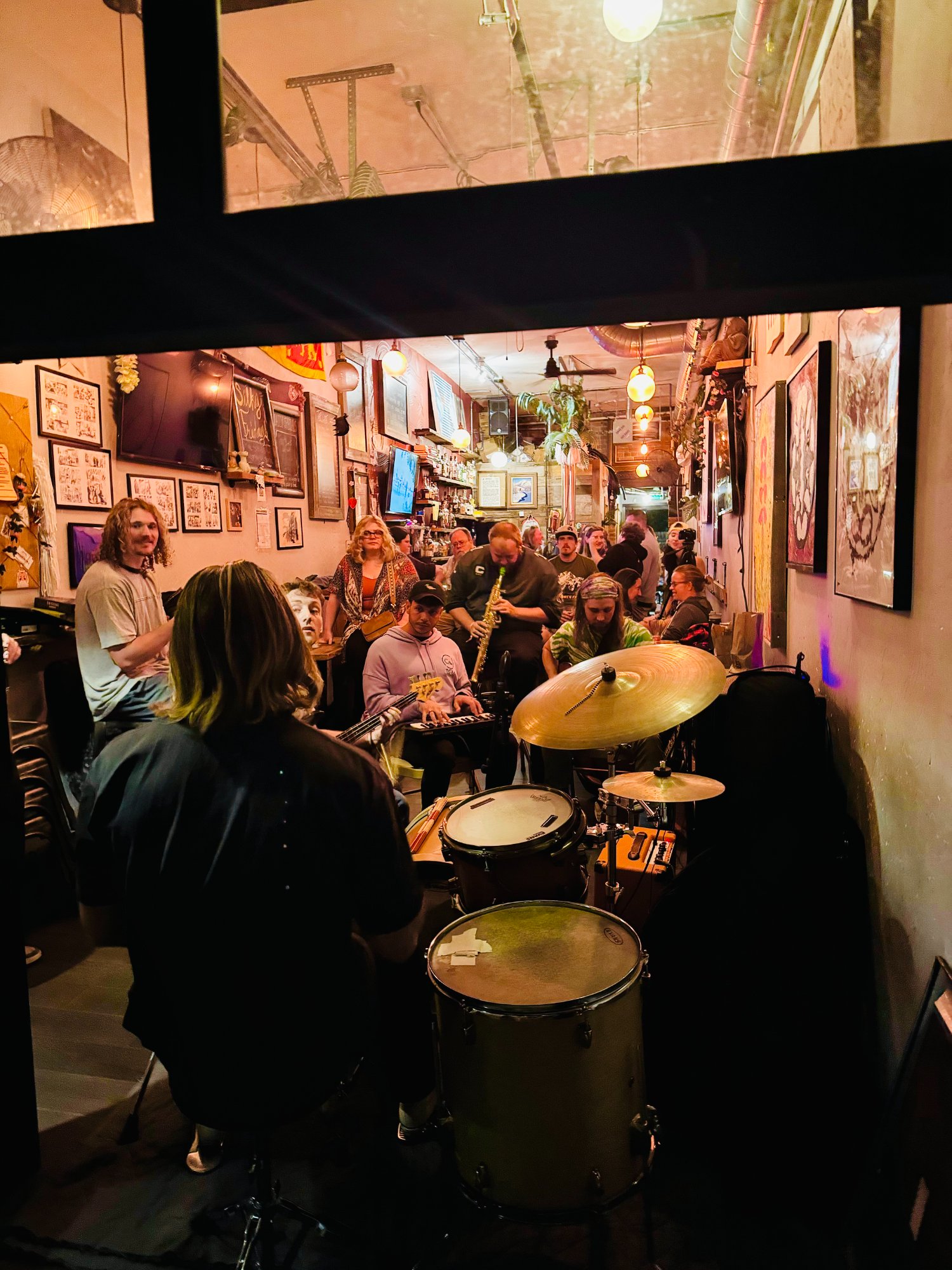
Every jam has its own personality, but the skeleton is consistent. Here’s a 7 to 10:30 night, using my Sunday jam as the template.
6:45 — Doors and load-in. The host band is setting up the back line: drums, amps, PA. This is the best fifteen minutes for a newcomer — the host isn’t busy yet. Walk up, introduce yourself, say it’s your first time — that one sentence changes your evening.
7:00 — The host set. The host band plays the first 30 to 45 minutes. That’s calibration, not filler: you hear the room’s volume, style, and level. Put your name on the list (at Goosetown it lives next to the mixing board) and listen for tunes you recognize.
7:45 — First jam sets. The host reads the list and builds the first group: drummer, bassist, a comping instrument, a soloist or two. Each set runs two or three songs — fifteen to twenty minutes — then rotates. Sign up early and you might be in the first or second round.
8:30 to 10:00 — The middle of the night. The jam at full speed: groups rotate every few songs and the level usually rises as the night goes on. Earlier sets are friendlier territory for newcomers — another reason to show up on time.
10:00 to 10:30 — The wind-down. The list runs out, the host calls a closer, and the hang happens — the half hour where bands form and numbers get exchanged. Don’t sprint for the door; the hang is half the value of the night.
What to Bring (and What to Leave Home)
The packing list is shorter than your nerves want it to be:
- Your instrument and a cable if you play guitar or bass — the back line means you plug into an amp that’s already there.
- A tuner. Tune before you’re called up, not on stage.
- Drumsticks if you drum; the kit stays, the sticks are yours. Horn players, you’re the easiest load-in in music.
- Three tunes you know cold, written down with keys, so you have an answer when the host asks what you want to play.
- Earplugs. Your future self says thanks.
Leave your amp, your pedalboard, and your binder of 200 charts at home — the jam runs on shared repertoire and provided gear. One exception: if a listing says “bring your own amp,” believe it — check the venue’s page or my Denver jam list before you go.
How the Sit-In Rotation Actually Works
The rotation is the part first-timers find most mysterious. The sign-up list collects names and instruments, and the host deals them into balanced groups — every set needs a rhythm section, and no set should be five guitarists staring at each other. That’s why someone who arrived after you might play first: drummers are currency.
When your name is called, you’ll join three or four other players, agree on a tune and key in about forty-five seconds, and play. Two or three songs later, the host rotates the group and deals the next hand. At a busy jam you might play twice in a night; at a quiet one, three or four times.
And your wait isn’t dead time: watch how the bassist locks with the kick, how soloists end their solos. You’re studying the exam before you take it.
The Five Unwritten Rules
Every jam posts rules somewhere. These are the unposted ones — the ones that decide whether the regulars are glad to see you back.
1. Talk to the host before you sign up
Tell them your instrument, your level, and that it’s your first time. Hosts aren’t gatekeepers; we’re matchmakers, and every piece of information makes it easier to put you in a set where you’ll sound good.
2. Only claim tunes you know cold
“I sort of know it” is the most dangerous phrase at a jam. Claim the tunes you can play through a memory lapse, a fast count-off, and a drummer you’ve never met. Nobody gets judged for calling a slow blues; people do get judged for calling Giant Steps aspirationally.
3. Serve the song, not your solo
Comp quietly when someone else is soloing, take one chorus — maybe two — and end your solo clearly so the next player can start. The fastest way to get invited back is to make other people sound good.
4. Match the stage volume
The room has a volume, set by the drummer and the host band. Find it and live slightly under it. The newcomer who turns up to be heard becomes the only thing anyone hears — not in the good way. And don’t noodle between songs.
5. Be there for more than your set
Listen to the groups before and after yours, applaud the other newcomers, stay for some of the hang. A jam is a community that happens to involve instruments, and players who treat it as a free stage find the rotation mysteriously slower next time.
Only Know Three Songs? That’s Genuinely Enough
Here’s the secret that calms most first-timers down: depth beats breadth. A starter kit that works at nearly any jam:
- A slow blues in G (or A, or E). The 12-bar form is the lingua franca; hold your role through it and you can play with strangers.
- One medium-tempo standard or soul tune you genuinely know — melody, form, where the bridge is.
- One funk vamp. A one- or two-chord groove where your whole job is pocket.
That’s it. You get called for what you can play, so three solid tunes makes you bookable on the spot, while twenty shaky ones makes you a liability on all twenty. If you want to build that kit faster, that’s most of what I teach: my bass lessons and guitar lessons in Denver aim squarely at playing with other people, and “ready for the Sunday jam” is a realistic three-month target.
How a Good Host Sets You Up to Win
This is the part nobody tells nervous first-timers: the host wants you to succeed, selfishly. A jam where beginners crash and burn stops getting beginners, and a jam without new blood dies. Here’s what I’m actually doing when you walk in.
I put a first-timer with my strongest rhythm section, not my flashiest — players who hold time and leave room. I call your tune in your key, count it at a tempo you can live in, and nod before anything changes: solo’s coming, head’s back, ending’s here. If you train wreck, I steer the band back to the top of the form and nobody ever knows. And I keep your first set short enough that you leave wanting more.
Multiply that by every decent host in the city, and the thing you’re afraid of — being exposed, alone, in front of strangers — becomes structurally impossible at a well-run jam. You’re surrounded by people whose job is to catch you.
Your First Night Will Be Fine
Here’s the realistic version. You’ll be nervous in the car. You’ll talk to the host and feel better. You’ll wait longer than you want to, play a slow blues that’s stiff for one chorus and genuinely good by the third, flub one transition nobody notices, and come off stage with your hands buzzing. Someone will say “nice playing.” You’ll drive home too awake to sleep and check the calendar for next week.
I watch this arc every Sunday. The gap between “bedroom player” and “person who jams” is one evening wide, and the door is open every week: Sunday at Goosetown Tavern, 7 to 10:30 PM, free, all levels — instrumental blues, funk, and jazz. For the full map, start with my Denver open jam guide. And if you’d rather walk in with your three tunes road-tested, get in touch about bass or guitar lessons — I’ll make sure your first jam is the easy kind.
Frequently Asked Questions
What should I expect at my first open jam?
Expect a sign-up list, a host band opening the night, then rotating sets of two to three songs with groups the host assembles. You’ll wait a round or two, play a short set, and rotate off. Most established jams provide drums, amps, and a PA, so you bring only your instrument and a cable.
What is proper open jam etiquette?
Talk to the host before signing up and say it’s your first time. Only call tunes you know cold, in a key you can name. Comp quietly behind soloists, keep your own solos to a chorus or two, match the stage volume, don’t noodle between songs, and stay to listen beyond your own set.
How do I prepare for a jam session?
Get three tunes performance-ready instead of twenty halfway there: a slow blues in a common key, one standard or soul tune you truly know, and one funk vamp. Practice them at multiple tempos, know the forms well enough to recover from a slip, and write your tunes and keys down for when the host asks.
Do I need to be good to go to an open jam?
You need to be solid on a few songs, not impressive on many. Jams run on roles: a bassist holding roots, a guitarist comping simply, a drummer keeping time. Hosts pair first-timers with strong rhythm sections and call manageable tunes. My Sunday jam at Goosetown Tavern in Denver is free, all levels, and built to be a welcoming first stage.
What happens if I mess up at an open jam?
Almost nothing. If you lose the form, a good host steers the band back to the top and the audience never notices. Everyone on stage has train-wrecked a tune, including the host. The only mistakes that follow you are etiquette mistakes — playing over others, refusing to rotate off, claiming tunes you can’t play.
Ready to take the stage? My Sunday jam at Goosetown Tavern runs 7 to 10:30 PM — free, all levels, instrumental blues, funk, and jazz. See the full Denver jam list, or get jam-ready faster with bass or guitar lessons — then come find me at the board.