Slap bass is a percussive right-hand technique where your thumb strikes the string like a drumstick and your index finger snaps a higher string for accent. It’s the sound of Larry Graham, Marcus Miller, and Flea — the technique that makes a bass line feel like a drum part and a melody at the same time. And it’s almost certainly the reason a lot of you picked up the bass in the first place.
In the run-up to playing a Marcus Miller tribute at Dazzle in 2025, I lived inside this technique — and the deeper I went, the more obvious it became that everything in slap traces back to two boring-sounding fundamentals: how the thumb strikes, and how the hands mute. Not licks. Not speed. Strike and mute.
So that’s how I teach it. Every brand-new slap student I take on in bass lessons in Denver starts the same way: thumb mechanics and muting first, licks in week two or three. This post is that first month, laid out as a 30-day plan you can run on your own.
One assumption before we start: you can already fret notes cleanly and play simple lines with reasonable time. If you’re starting from absolute zero, read how long it takes to learn bass first and come back to slap once basic lines feel comfortable. And if slap is the thing pulling you toward bass over guitar — you’re not alone, and I wrote about that decision in bass vs. guitar: which should you learn first?
Why Mechanics Come Before Licks
Here’s what happens when someone learns a slap lick before they learn the slap technique: they can sort of play the lick, but it sounds like someone hitting a bass with a shoe. The notes are there. The groove isn’t. And because the lick “works,” they never go back and fix the strike — so every lick they learn afterward inherits the same dead tone.
Slap is unforgiving that way. In fingerstyle, a slightly sloppy attack still produces a usable note. In slap, the attack is the note. If the strike is wrong, there’s nothing downstream to save it.
The good news: the mechanics are learnable in days, not months. Adults actually have an advantage here, because the fix is about attention, not athleticism.
The Mistake That Kills Everyone’s Tone: The Buried Thumb
If you take nothing else from this post, take this section.
The number one mistake I correct — in nearly every new slap student, without exception — is that the thumb buries into the strings instead of bouncing off them. The thumb strikes the string and then keeps pushing through, coming to rest against the string below (or against the fingerboard itself).
That single habit ruins two things at once:
-
The tone. When the thumb pushes through, it chokes the string the instant after it strikes it. You get a thud instead of a ring — all attack, no note. The bright, piano-like “thwack” that makes slap sound like slap comes from the string being free to vibrate the millisecond after impact.
-
The rebound. Slap is a cycle: strike, bounce, reset, strike. If your thumb is buried in the strings, it has to be pulled back out before the next note. That recovery motion is slow, and it’s exactly why people plateau at low tempos. They’re not slow — their thumb is stuck.
The image I use with every student: bounce the thumb like a basketball, don’t push it like a doorbell. A basketball hits the floor and leaves immediately — the floor sends it back. Your thumb should hit the string and be gone, letting the string’s own tension throw it back off. If you watch slow-motion footage of any great slap player, the thumb is in contact with the string for almost no time at all.
Test yourself right now: slap an open E and freeze. Where is your thumb? If it’s resting on the A string or pressed into the fingerboard, you’re burying. If it’s hovering back off the strings, ringing note underneath it, you’re bouncing. That one diagnostic will tell you more than an hour of YouTube.
How to Practice This Plan: 15 Focused Minutes
Before the week-by-week: a word about time, because most of the adults I teach have jobs, families, and maybe 30 minutes a day for bass on a good day.
For slap technique, 15-20 focused minutes a day beats an hour of mush. Slap is a motor skill, and motor skills are built by short, attentive repetition — not marathon sessions where your attention fades and you spend the back half rehearsing your mistakes. Set a timer, work the day’s one assignment with full attention on the strike and the muting, and stop. If you have more time, great — spend it playing music you already know, not grinding the new technique past the point of focus.
Here’s the month at a glance:
| Week | Focus | The win |
|---|---|---|
| 1 | Thumb strike + left-hand muting | A clean, bouncing thumb tone with dead notes that are actually dead |
| 2 | The pop + the octave shape | Thumb-root, pop-octave, slow and even |
| 3 | The octave funk groove + ghost notes | One full groove, locked to a metronome |
| 4 | Tempo, new roots, vocabulary | The same groove anywhere on the neck, faster, with feel |
Week 1: The Thumb Strike and the Art of Silence
No licks this week. No pop, either. Just the thumb — and the muting that makes the thumb sound good.
Where to strike: at the very end of the fingerboard, right around the last fret — not back over the pickups. The string has the most bounce there, which gives you the brightest attack and the most rebound for your thumb. Striking over the pickups is like dribbling a basketball on carpet: the string is stiffer there, it fights you, and the tone goes dull.
How to strike: rotate from the forearm — like turning a doorknob or shaking water off your hand — and let the side of your thumb’s knuckle contact the string. Strike and leave. Bounce, don’t push. Spend the first few days on nothing but open E and open A, one note at a time, listening for a clear pitch with a percussive front edge. Thud means buried. Ring means bounce.
The other half: muting. Slap is loud and percussive, which means every string you’re not playing wants to ring sympathetically and turn your groove into soup. Your fretting hand fixes this. When you fret a note, let your remaining fingers lie gently across the other strings. When you want a dead note — a pitchless click, the heartbeat of funk — release the fretted note to a light touch (don’t lift off) and lay the whole hand flat across the strings, then slap. A dead note should be completely dead: no pitch, no hum, just “tk.”
Week 1 daily routine (15 min): 5 minutes of open-string thumb strikes with the freeze test. 5 minutes of fretted notes — try the A at the 5th fret of the E string — alternating ringing note and dead note. 5 minutes of slow quarter notes with a metronome at 60 bpm, alternating one pitch, one dead note. Boring? Slightly. But this is the week that decides whether you’ll sound like a slap player or a shoe.
Week 2: Add the Pop — and Your First Shape
Now the index finger joins. The pop is the bright snap that answers the thumb: you hook the tip of your index finger under a higher string, pull it slightly away from the body, and let it go so it snaps back against the frets. Like the thumb, it’s a small motion — the same forearm rotation that drives your thumb down swings your index up. One motion, two attacks. Don’t yank from the elbow; if popping hurts or your finger gets stuck under the string, you’re digging in too deep. Just the fingertip.
And here’s your first assignment — the same one I give every slap student before any named song: a simple octave funk pattern. Thumb on the root, pop on the octave. That’s the whole assignment, and it’s been the backbone of funk bass lines for fifty years.
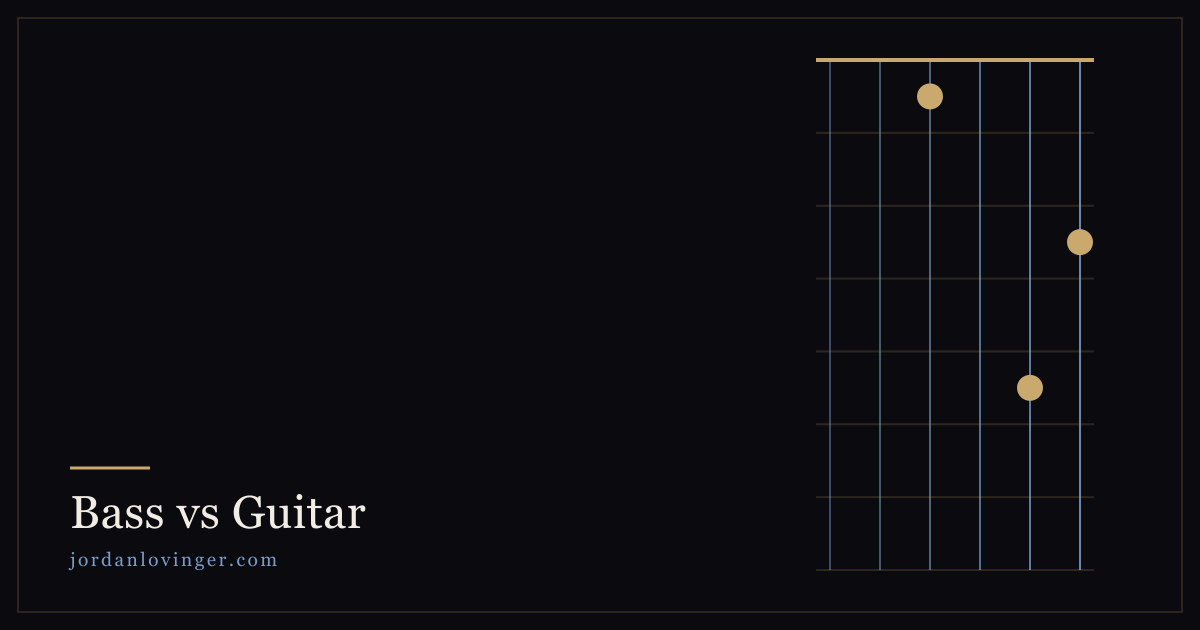
The shape is built on the most useful piece of geometry on the bass: an octave is always two strings up and two frets up. Here it is with the root on A — thumb hits the A at the 5th fret of the E string, and your index pops the octave A at the 7th fret of the D string:
Fret the low A with your index finger and the octave with your ring finger or pinky — that hand position covers the shape with no stretching, and your index naturally lies across the other strings for muting. The shape is fully movable: put the root anywhere on the E or A string, count two strings up and two frets up, and the octave is waiting. The names change; the shape never does.
Week 2 daily routine (15-20 min): 5 minutes of thumb-strike maintenance from Week 1 (don’t let the bounce decay). 5 minutes of pops alone on the D string — clean snap, no buzz-out. Then 5-10 minutes of slow alternation: thumb-root, pop-octave, quarter notes at 60 bpm. Even volume between thumb and pop is the goal — most beginners’ pops are twice as loud as their thumb. Listen for it and level them out.
Week 3: The Groove, End to End
This week the exercise becomes music. You’re going to take the octave pattern and play it as an actual funk groove — with a metronome, with dead notes, start to finish.
To make it as easy as physically possible, we move the root to open E: the thumb hits the open E string, and the pop lands on the octave E at the 2nd fret of the D string.
This is the friendliest version of the shape on the instrument — the root needs no fretting at all, so your entire left hand is free to do the muting work and grab that one fretted octave. (The flip side: an open string rings until something stops it, so your fret hand has to actively shut the E down between notes. Good — that’s exactly the skill Week 1 built.)
The groove: with a metronome at 70 bpm, play thumb-E on beats 1 and 3, pop-octave on beats 2 and 4. Once that’s steady, fill the gaps with ghost notes — lay the fret hand flat across the strings and slap pitchless “tk” notes on the eighth-note offbeats. Now you’ve got thumb, pop, and ghosts woven into one continuous line. That’s not an exercise anymore. That’s a funk bass part — the skeleton of “Higher Ground,” half of Graham Central Station, and a thousand grooves between.
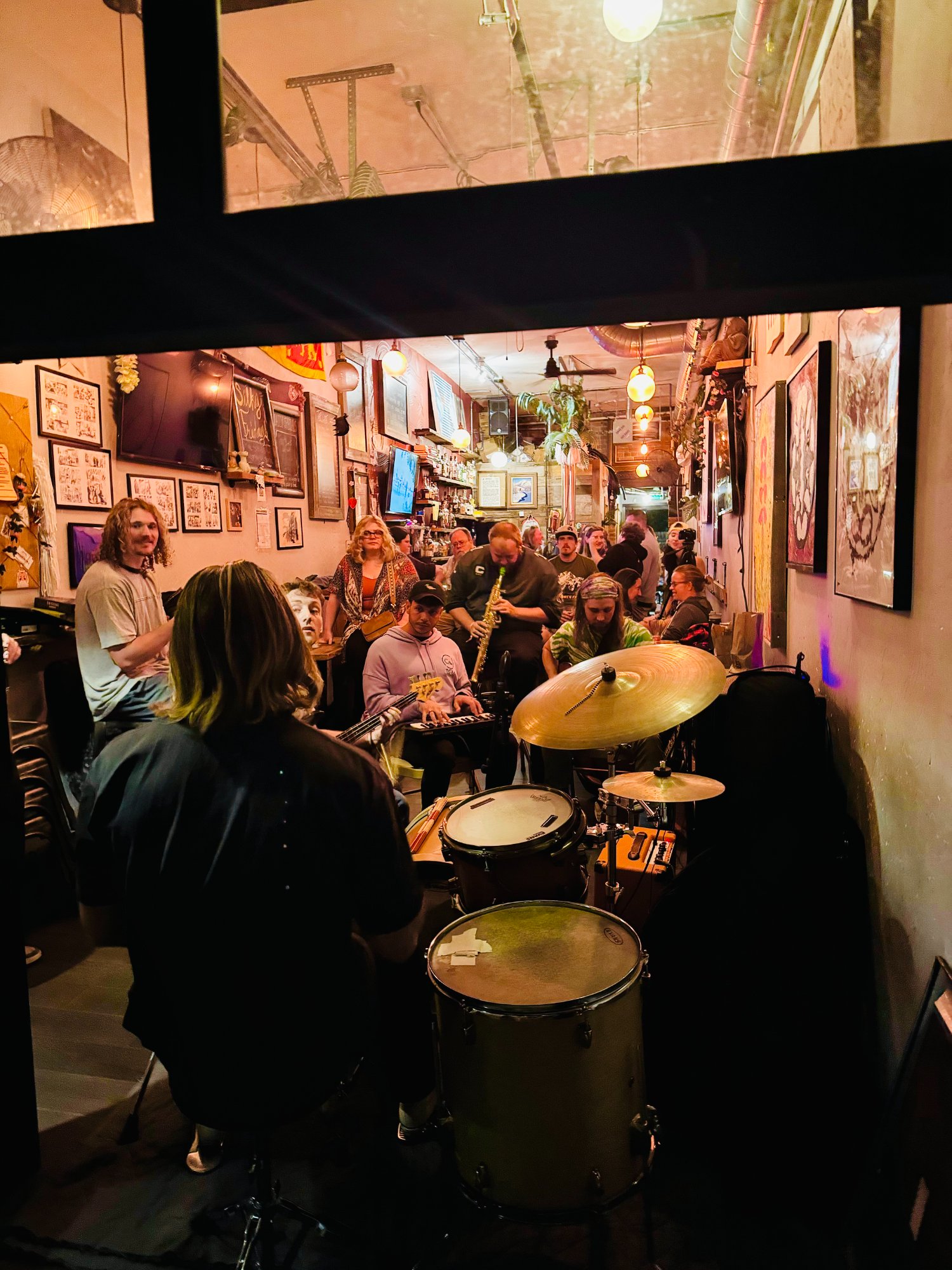
It happens all the time at my Sunday jam at Goosetown Tavern: a bassist pulls me aside to ask how to get started with slap, then demonstrates something fast and buried they learned from a video. I always show them this exact groove at 70 bpm instead. Played clean — bouncing thumb, popping octave, dead notes that are actually dead — it sounds better at slow tempo than the fast version sounds at any tempo. The room responds to groove, not speed. Every time.
Week 3 daily routine (15-20 min): metronome on, run the open-E groove for two minutes at a stretch without stopping. When a strike goes bad — and it will — keep the time and fix it on the next note. Recovering inside the groove is the real skill. Nudge the metronome up 4-5 bpm only when a full two-minute run feels easy.
Week 4: Speed, New Roots, First Vocabulary
The last week is about taking the one thing you can do and turning it into something you can use.
Tempo: keep nudging the metronome — 80, 90, 100 bpm. The buried thumb will try to come back as you speed up; it always does. The moment the tone goes thuddy, drop back 10 bpm and re-establish the bounce. Speed you can’t keep your tone at isn’t speed you own yet.
New roots: move the fretted octave shape from Week 2 around the neck. G at the 3rd fret of the E string, octave at the 5th fret of the D string. C at the 3rd fret of the A string, octave at the 5th fret of the G string. B at the 2nd fret of the A string, octave at the 4th fret of the G string. Same shape, same fingering, every time — two strings up, two frets up. Run the full groove on each root. Within a few days you can slap over any one-chord funk vamp someone calls.
First vocabulary: now — and only now — licks earn their place. Vary the rhythm of the groove: double up the thumb (two sixteenths on the root), displace a pop, leave a beat empty. Steal one small move from a recording you love and graft it onto your octave groove. Because the strike and the muting are already handled, new vocabulary actually sounds like the record instead of a muddy approximation of it.
After Day 30
Thirty days in, you’ll have something most self-taught slappers never get: a clean foundation. A thumb that bounces, dead notes that are dead, one groove you can play anywhere on the neck at a respectable tempo. From here, vocabulary stacks fast — every Marcus or Larry or Flea line you learn is some combination of thumb, pop, and ghost notes you already own.
Two honest notes. First, slap is one vocabulary, not the whole instrument — if you want the skill that gets you called back for jazz and blues gigs, walking bass lines are the other half of that conversation, and they reward the same patient, mechanics-first approach. Second, slap technique is one of those things where a single corrected rep is worth fifty unsupervised ones — the buried thumb in particular is much easier to fix when someone catches it in the room with you. That’s a big part of what I do in bass lessons in Denver, in person and online.
Frequently Asked Questions
What should a beginner learn first in slap bass?
Thumb mechanics and muting — before any licks. That means a thumb strike that bounces off the string instead of pushing through it, and left-hand muting that keeps unplayed strings silent and makes dead notes completely pitchless. Licks built on top of clean mechanics sound like the records; licks built on a buried thumb sound dull at every tempo. A simple octave funk pattern — thumb on the root, pop on the octave — is the ideal first assignment.
Where do you hit the string when slapping bass?
Strike at the very end of the fingerboard, around the last fret — not back over the pickups. The string has the most flexibility and rebound there, which gives you a brighter attack and bounces your thumb back off the string for the next note. Use the side of your thumb’s knuckle, driven by a forearm rotation like turning a doorknob, and let the thumb leave the string immediately after impact.
Why does my slap bass sound dead or thuddy?
The most common cause is a buried thumb: striking the string and pushing through it so the thumb comes to rest against the next string or the fingerboard. That chokes the string the instant after impact, killing the ring, and it also kills the rebound you need to play the next note quickly. The fix is to bounce the thumb like a basketball — minimal contact time, letting the string’s tension throw the thumb back off. If you freeze right after a slap and your thumb is resting in the strings, you’re burying.
How long does it take to learn slap bass?
With 15-20 minutes of focused daily practice, most players get a clean thumb strike and pop within two weeks and a solid octave funk groove with ghost notes by day 30. Building real vocabulary — fills, double thumbing, faster tempos — takes several months beyond that, and the timeline depends heavily on whether your basic fretting and timing are already solid. For the bigger picture on overall progress, see how long it takes to learn bass.
Do I need a special bass or setup to play slap?
No — any standard four-string bass tuned E-A-D-G can slap. Roundwound strings and a reasonably low action make the technique brighter and easier, and fresh strings help, but none of it is required to learn the mechanics. The classic slap tone is associated with bolt-on Fender-style basses, yet the bounce of the thumb matters far more than the gear: a player with clean technique sounds percussive and alive on almost anything.
Want someone watching your thumb while you build this? I teach private bass lessons in Denver — in person and online — and slap technique is one of my favorite things to coach. Reach out about lessons and we’ll get that thumb bouncing.